
AI Customer Service
AI Customer Service Needs a Human Handoff: A Practical 2026 Playbook
Learn when AI customer service should hand off to a person, what context to transfer, and which metrics help protect trust and resolution quality.
By Daniel Michaelis · 2026-08-26
AI customer service can make routine help faster, but it should never become a locked door between a customer and your company. A 2026 Gartner survey found that 50% of customers said GenAI made service interactions easier, while 87% said access to a human was essential when a company used GenAI. The message is not "avoid AI." It is "design the exit before you automate the entrance."
An effective AI customer service human handoff happens when the customer asks for a person, the request exceeds the AI's authority, risk or emotion rises, confidence falls, or repeated attempts fail. The transfer should carry the verified facts, conversation summary, actions already taken, customer identity, risk flags, and a clear owner. The customer should not have to start again.
Key Takeaways
- AI should resolve narrow, routine requests and escalate work that needs judgment, authority, empathy, or exception handling.
- A handoff is not complete until a real queue or person receives the case with usable context.
- Measure resolution quality, transfer completion, repeat explanations, reopened cases, and customer satisfaction alongside self-service.
- Start with one workflow, explicit boundaries, and a monitored pilot before expanding automation.
What is an AI customer service human handoff?
An AI-to-human handoff is a controlled transfer of responsibility, conversation state, and relevant context from an automated service agent to an accountable person or staffed queue. It is more than showing a phone number, sending an email, or telling the customer that someone will respond.
A complete handoff has three parts:
- A trigger: The system recognizes that the request should leave AI control.
- A context packet: The next person receives the customer's goal, verified facts, prior steps, and current status.
- An accountable destination: The case enters a real queue with an owner, channel, and honest expectation for what happens next.
If any part is missing, the interaction may look automated while the operational work still falls apart. The most damaging version is a false transfer: the AI says it is connecting the customer, but no person or monitored queue receives the request.
This is why the handoff should be designed as part of the workflow, not added after the chatbot is live. Wavefront's AI chatbot and automation systems already connect customer conversations, lead capture, booking, messaging, and back-office workflows. The same connected design is what makes a handoff useful instead of cosmetic.
Why does human access matter even when customers use AI?
Customers are willing to use AI for real work, but willingness depends on control. Gartner surveyed 3,566 B2B and B2C customers in February and March 2026. It found that 58% of customers who use GenAI had used it to complete a task on their behalf; among B2B customers, the figure was 74%. Yet 87% still considered human access essential (Gartner, August 2026).
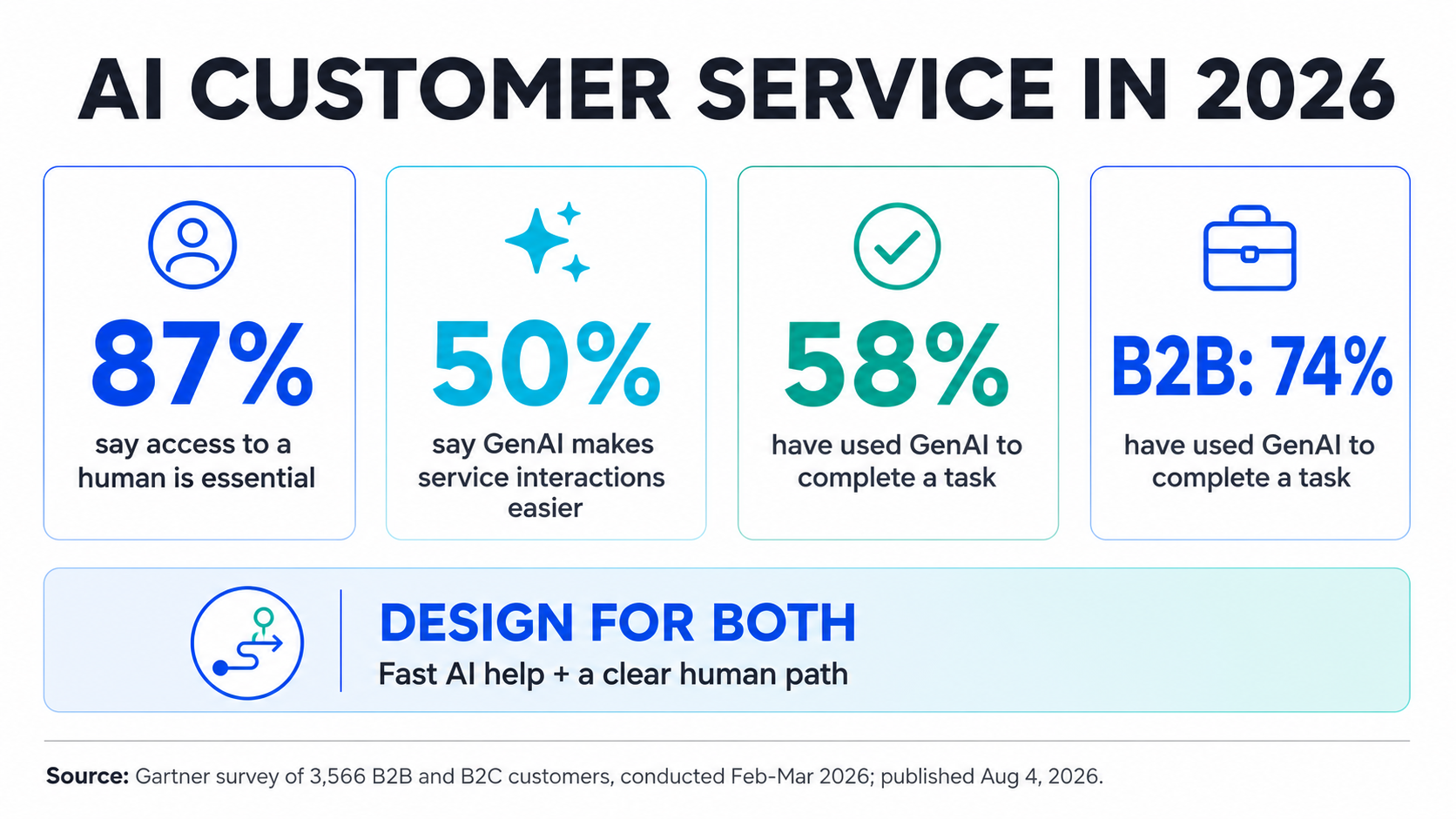
That combination matters. Customers do not necessarily reject automation. They reject being forced through an automation loop after the system has stopped helping.
Adoption is also moving quickly. Salesforce's 2026 Agentic Enterprise Index analyzed organizations that consistently used Agentforce from February 2025 through April 2026. In that cohort, the average number of activated agents per organization increased nearly threefold (Salesforce, August 2026). This is vendor-platform data, not a measure of every business, but it shows why operating rules now matter: more agents are moving from demos into real customer workflows.
The practical conclusion is simple. The competitive advantage is not the highest possible automation rate. It is a service journey that resolves routine needs quickly and moves consequential work to a person without losing time, facts, or trust.
Which conversations should AI handle, assist with, or escalate?
AI is strongest when the task is narrow, the source of truth is available, the allowed action is explicit, and a mistake is easy to reverse. Human ownership should increase as judgment, emotion, risk, or exception authority increases.
| AI can usually handle | AI can assist a person | A person should own |
|---|---|---|
| Order or application status from a live system | Summarizing a long conversation | A billing dispute or refund exception |
| Business hours and approved FAQs | Drafting a response for review | Legal, compliance, safety, or rights-sensitive issues |
| Appointment availability and booking within set rules | Gathering account history and source links | A customer who explicitly asks for a person |
| Lead qualification using approved questions | Routing to the correct team | High emotion, distress, or threatened cancellation |
| Basic troubleshooting with verified steps | Suggesting next actions within a playbook | An action outside the AI's permission or confidence boundary |
This is not a permanent classification. A task can move between columns as your data, integrations, controls, and evaluation evidence improve. A price quote, for example, may be safe to automate when it comes from a governed calculator with current rules. It is not safe when the AI is improvising from old marketing copy.
What should trigger an immediate handoff?
A useful escalation policy combines customer choice, risk rules, system confidence, and workflow state. These seven triggers cover most customer-facing deployments:
- The customer asks for a person. Honor direct phrases such as "human," "representative," or "call me." Do not require several failed attempts first.
- The request needs authority the AI does not have. Refund exceptions, contract changes, credit decisions, policy waivers, and account closures may require an authorized employee.
- The subject is sensitive or high impact. Route health, safety, legal, compliance, discrimination, fraud, and similar matters according to a defined human process.
- Frustration or distress rises. Repeated negative sentiment, urgent language, or a complaint about the AI itself should reduce the threshold for transfer.
- Confidence falls below the task threshold. Confidence should be tied to the use case. An FAQ answer and a billing action should not share the same threshold.
- The conversation repeats or stalls. Two failed attempts, contradictory answers, or repeated requests for the same information are signs that the workflow is no longer progressing.
- A required system is unavailable. If the CRM, order system, calendar, or identity check fails, the AI should not pretend it completed the action.
Zendesk's current implementation guidance similarly recommends deciding the escalation strategy before launch and accounting for complexity, urgency, staffing, agent availability, channel volume, and what the AI can collect before transfer (Zendesk, updated August 21, 2026). The exact policy will differ by business, but it should be written, testable, and visible to the team that owns the outcome.
What context should move with the customer?
The receiving person needs a compact, source-linked case file rather than a raw transcript dump. A practical handoff packet contains six fields:
- Customer and channel: Verified identity fields the workflow is authorized to use, plus the current channel and callback preference.
- Intent: One sentence stating what the customer is trying to accomplish.
- Verified facts: Order number, appointment, product, account state, or policy details pulled from approved systems, with source links where the interface supports them.
- Actions already taken: Questions asked, troubleshooting completed, forms submitted, and tool actions attempted.
- Current state and risk flags: Why the AI stopped, what remains unresolved, sentiment or urgency, and any sensitive-data handling note.
- Destination and owner: The queue or person receiving the case, the expected next action, and the honest response window.
Collect only what the workflow needs and is allowed to use. A long transcript may contain unrelated personal information, outdated facts, or model-generated statements that should not be treated as verified. The summary should separate customer-provided information, system-verified facts, and AI interpretation so the human can see the difference.
The customer also needs a concise confirmation: what was transferred, where it went, and what will happen next. If live staff are unavailable, say so. Create a ticket, callback request, or scheduled follow-up that your team can actually honor rather than simulating a live transfer.
How do you build and test the handoff workflow?
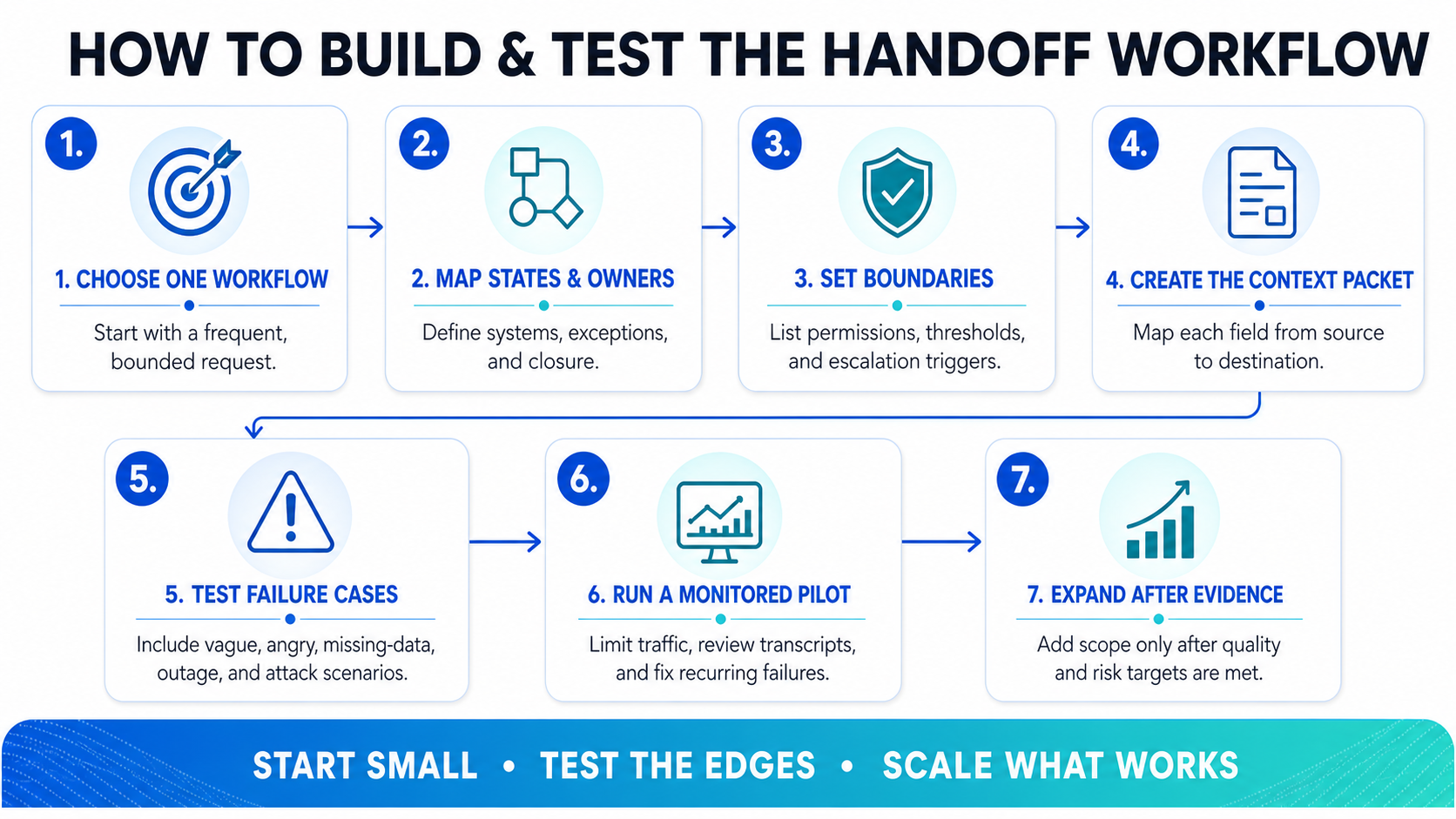
Build the handoff around a defined service process, not around a general chatbot. A reliable sequence looks like this:
- Choose one bounded workflow. Start with order status, appointment booking, lead qualification, or another frequent request with a clear source of truth.
- Map the states and owners. Document where the conversation begins, which systems it reads or changes, who owns exceptions, and how the case closes.
- Set permissions and boundaries. List allowed actions, prohibited actions, confidence thresholds, required confirmations, and immediate escalation triggers.
- Create the context packet. Map every field to a source and destination. Confirm that the CRM, help desk, phone system, or inbox receives it correctly.
- Test realistic failure cases. Include vague requests, angry customers, missing records, system outages, repeated questions, prompt attacks, and requests outside scope.
- Run a monitored pilot. Limit traffic, review transcripts, compare AI outcomes with human decisions, and fix recurring failure patterns.
- Expand only after evidence. Add intents or actions when the current workflow meets quality and risk thresholds over a meaningful sample.
NIST's voluntary AI Risk Management Framework calls for organizations to define human-AI roles and responsibilities, test systems before deployment and during operation, and document risk measurements (NIST AI RMF Core). That guidance translates directly into customer service: someone must own the policy, someone must monitor performance, and someone must be able to stop or change the workflow.
Testing can improve both quality and automation. A 2026 ACM KDD paper describing five production customer-support deployments at Nubank reported that an evaluation-driven approach improved outcomes across use cases. In one card-delivery deployment, the new agent showed a 37 percentage-point gain in AI transactional NPS and a 29 percentage-point gain in self-service rate versus earlier agent variants (Gupta et al., 2026). Those are case-specific results, not a promise of typical performance. Their value is methodological: offline evaluation, human review, online testing, and production measurement worked together.
Which metrics show whether the handoff works?
Measure whether customers reach a correct outcome with reasonable effort. Deflection alone can rise while trust and resolution quality fall.
| Metric | What it reveals | Watch for |
|---|---|---|
| Verified self-service resolution | Requests completed correctly without human work | Do not count abandoned or reopened cases as resolutions |
| Escalation rate by intent | Which workflows need human support | A high rate may signal a bad use case or missing knowledge, not a bad agent |
| Transfer completion rate | Whether escalated cases reach the intended queue or person | "Transfer started" is not the same as "transfer received" |
| Repeat-explanation rate | How often customers must restate the issue | Rising rates usually mean the context packet is incomplete or ignored |
| Reopened-contact rate | Whether a supposedly resolved issue returns | Track within a defined time window and by intent |
| CSAT for AI-only, assisted, and transferred cases | How experience differs by service path | Compare similar issue types rather than blending all contacts |
| Unauthorized-action and correction rate | Whether the system exceeds its rules or creates rework | Treat high-impact errors as incidents, not averages |
Review these metrics by intent, channel, customer segment, and outcome. A strong overall number can hide one dangerous workflow. Keep a sample of conversations for human review, record why people override the AI, and turn recurring failures into test cases for the next release.
What should a small or mid-sized business do first?
Start with one high-volume request that has a reliable data source and a clear human owner. Over 30 days, you can map the workflow, define the handoff contract, connect the required systems, test failure cases, and run a limited pilot. The goal is not to automate everything in a month. It is to learn whether one workflow can save time without lowering service quality.
Before buying another tool, inventory what you already have: website chat, phone, inboxes, calendar, CRM, help desk, policy documents, and analytics. The right solution may be a chatbot, a voice agent, deterministic automation, an internal assistant, or a combination. Wavefront's service and project overview and portfolio show how connected systems can combine customer experience with operational workflows.
Frequently asked questions
Should every AI customer-service system offer a human option?
For customer-facing service, the system should provide a clear human path appropriate to the business's staffed channels and risk profile. That does not require a live person at every hour. It requires honest availability, a real queue or callback process, and immediate escalation for requests the AI should not own.
Is a bad handoff a chatbot problem or an integration problem?
It is usually a workflow problem that spans both. The AI must recognize the trigger, but the CRM, help desk, phone system, or inbox must accept the case, preserve context, assign ownership, and report the result. Changing the model alone will not repair a broken queue.
What happens outside business hours?
The AI can continue handling approved self-service tasks. When a person is needed, it should state that live staff are unavailable, collect only necessary information, create a real ticket or callback request, and give an expectation the business can meet.
Can the AI collect information before transferring the customer?
Yes, when the data is necessary, authorized, and handled under the business's privacy and security rules. Collecting an order number or preferred callback method can speed the next step. Asking for sensitive information that the receiving person does not need increases risk and customer effort.
Build the human path before you scale the AI path
AI customer service works best as part of a service system with boundaries, connected data, measurable outcomes, and accountable people. Let AI handle the repeatable work. Give customers a clear route to human judgment when the situation demands it. Then use real outcomes to decide what to automate next.
If you are deciding which customer workflow is ready for AI, request a Free AI Readiness Audit. Wavefront Studio can help you examine the process, data, integrations, handoff points, and operating risks before you invest in a larger rollout.
About the author
Daniel Michaelis writes for Wavefront Studio about practical AI systems, automation, and digital growth for businesses.