
Wavefront field note
AI Search Visibility Audit: How to Measure and Improve Brand Citations
Run an AI search visibility audit that measures brand mentions, citations, answer accuracy, entity clarity, and qualified business outcomes.
By Daniel Michaelis · 2026-08-27

An AI search visibility audit checks whether answer engines can discover your pages, identify your business correctly, retrieve useful passages, cite your content, and describe your offer accurately for the questions buyers ask. It is not a replacement for SEO. It adds an answer-level measurement layer to technical SEO, content quality, entity clarity, and reputation signals.
Google's own guidance is unusually direct: there are no additional technical requirements for appearing in AI Overviews or AI Mode. A page must be indexed and eligible to appear in Google Search with a snippet, and Google's established people-first content and technical practices still apply. In June 2026, Google also announced a limited rollout of dedicated generative AI performance reports in Search Console, giving some site owners a separate view of visibility in AI Overviews, AI Mode, and generative features in Discover.
The practical response is not to chase a secret “GEO hack.” It is to measure the new surfaces, make important answers easy to extract, strengthen the evidence behind them, and verify what the systems actually say.
Key Takeaways
- Keep technical SEO and indexability as the foundation.
- Build a prompt set around real buyer questions, not vanity prompts.
- Record citations, mentions, accuracy, and answer role separately.
- Make pages direct, self-contained, and evidence-rich.
- Track business impact instead of treating citations as the final goal.
Step 1: Confirm that search systems can access the right pages
By the end of this step, you should know whether the pages that explain your products, services, proof, policies, and expertise are crawlable, indexable, and eligible to appear with snippets.
Check:
- Index status in Google Search Console and Bing Webmaster Tools
- Robots directives and page-level indexing controls
- Canonical URLs
- Rendered content, especially when JavaScript is involved
- XML sitemap inclusion and last-modified accuracy
- Internal links to important pages
- Mobile usability and page experience
- Whether essential answers appear in HTML, not only images or scripts
Do not create special “AI pages” that users cannot navigate to. The content should fit the site's information architecture and solve a genuine buyer question. If a service page is thin, an FAQ or guide can support it, but the service page still needs a clear explanation of the offer, audience, process, boundaries, and next step.
Step 2: Create a repeatable buyer prompt set
By the end of this step, you should have a small test set that reflects how people compare, evaluate, and verify providers.
Start with 25 to 50 prompts across five groups:
- Category: “What companies provide [service] for [buyer]?”
- Problem: “How can a [business type] solve [operational pain]?”
- Comparison: “What is the difference between [approach A] and [approach B]?”
- Trust: “Is [brand] experienced in [use case]?”
- Decision: “What should I ask before hiring an [AI service provider]?”
Include branded and non-branded prompts, local modifiers where relevant, and natural variations. Avoid prompts designed only to force your company name into the answer. They create flattering screenshots but weak market evidence.
Record the engine, account or mode, date, location if relevant, exact prompt, and whether the result is reproducible. Answer systems vary by model, retrieval index, personalization, and time. One response is a sample, not a stable ranking.
Step 3: Establish an AI visibility baseline
By the end of this step, you should know how the brand appears today and where the gaps are.
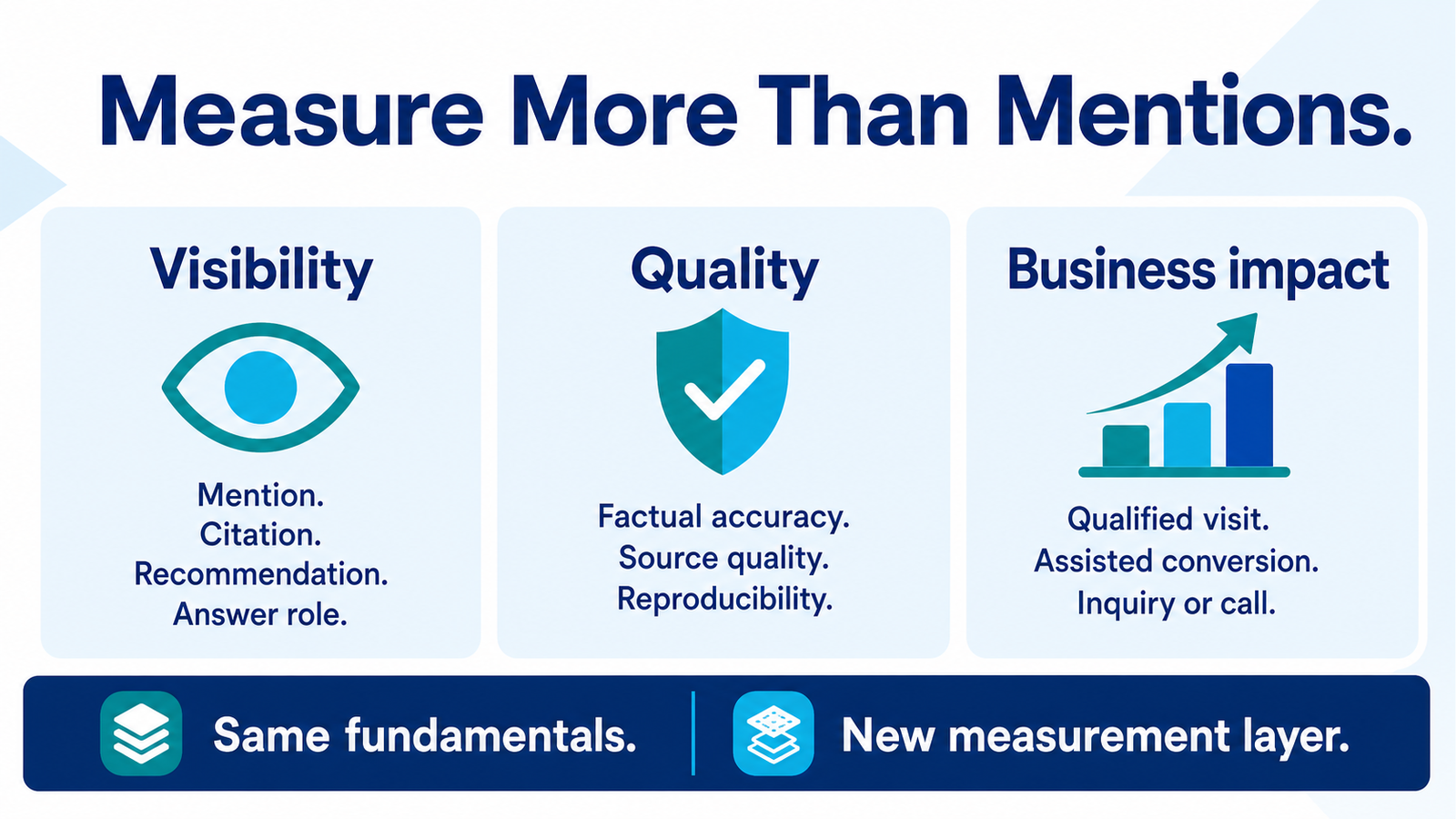
For each prompt, record these fields separately:
| Measure | Question it answers |
|---|---|
| Mention | Did the answer name the brand? |
| Citation | Did it link to a brand-controlled page? |
| Recommendation | Did it present the brand as an option? |
| Answer role | Was the brand a definition, example, source, comparison, or recommendation? |
| Position | Where did the mention appear in the response? |
| Accuracy | Were services, location, proof, and limitations described correctly? |
| Source quality | Did the answer rely on the official site, a review platform, media, or an unknown page? |
| Outcome | Did the visibility produce a qualified visit, inquiry, or assisted conversion? |
Do not combine all of this into one unexplained score. A mention without a citation is different from a sourced recommendation. A citation that repeats outdated information may be worse than no citation because it creates false confidence.
Step 4: Diagnose the reason for weak visibility
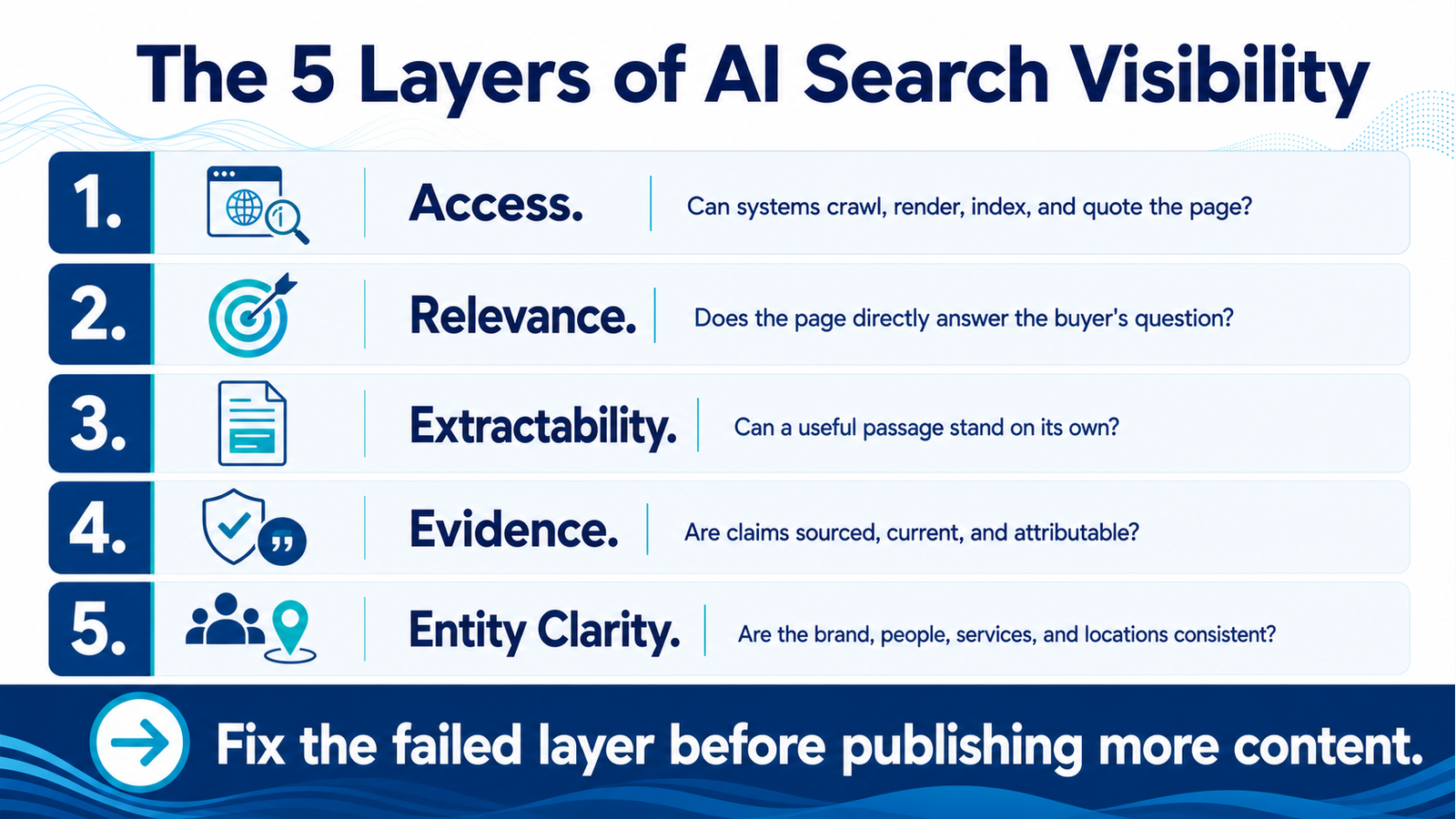
Weak AI visibility usually falls into one of five layers:
- Access: The page is blocked, not indexed, difficult to render, or isolated.
- Relevance: The site does not clearly answer the prompt.
- Extractability: The answer is buried, vague, dependent on surrounding context, or presented only visually.
- Authority and evidence: The claim lacks proof, attribution, expert ownership, or corroboration.
- Entity clarity: The business name, services, location, people, or relationships are inconsistent across sources.
Fix the layer that failed. Adding FAQ schema will not solve an unindexed page. Publishing more generic articles will not solve a confused brand identity. Repeating the company name will not make an unsupported claim credible.
Step 5: Improve the passages answer engines can use
By the end of this step, each priority page should contain at least one clear, self-contained answer to its primary question.
Use these editing rules:
- Answer the core question in the first useful paragraph.
- Give each section one clear job.
- Use descriptive question or outcome-based headings.
- Define terms before expanding on them.
- Keep factual claims close to their source links.
- Add dates and methodology to original data.
- Name the author and explain relevant expertise.
- Use examples, decision criteria, checklists, and tables where they help.
- Make service boundaries explicit.
- Link naturally to the page where a buyer can act.
Google states that helpful, reliable, people-first content and existing SEO best practices remain the right approach. That makes clarity valuable twice: people understand the page faster, and retrieval systems can isolate a passage without inventing missing context.
Step 6: Strengthen entity and evidence consistency
By the end of this step, a reviewer should find the same essential facts wherever the business is represented.
Create an entity sheet with the approved business name, website, address, service area, phone, leadership, core offers, short description, and proof points. Compare it against:
- Website headers, footers, and contact pages
- Organization and local business structured data
- Google Business Profile and Bing Places
- LinkedIn and relevant professional profiles
- High-quality directories and review platforms
- Press, association, partner, and event pages
- Author biographies and case studies
Correct meaningful conflicts at the source. Do not manufacture third-party mentions or flood low-quality directories. The goal is an accurate, corroborated public record.
Step 7: Connect AI visibility to business outcomes
AI citations are an intermediate measure. The business goal is qualified discovery and trust that contributes to revenue, recruitment, support, or another defined outcome.
Report AI visibility alongside:
- Traditional search impressions, clicks, and conversions
- Referral visits from answer engines where identifiable
- Landing pages receiving those visits
- Branded search change
- Assisted conversions
- Qualified form submissions and calls
- Sales feedback on how prospects discovered the company
- Accuracy issues and corrections completed
Where Google's new generative AI reports are available, use them as an additional view rather than assuming they explain every answer engine. Keep manual prompt testing consistent enough to spot changes, but do not promise perfect measurement across platforms.
A 30-day audit cadence
Week 1: Crawl, index, render, internal-link, and entity checks.
Week 2: Run the prompt baseline and classify mentions, citations, roles, accuracy, and sources.
Week 3: Improve the highest-value pages and repair conflicting facts.
Week 4: Re-test the same prompts, annotate changes, review traffic and lead quality, and choose the next content or technical action.
Keep the prompt set stable for comparison. Add new prompts in a separate cohort so the baseline does not move every month.
Common mistakes to avoid
Treating GEO as unrelated to SEO. Google explicitly ties eligibility to ordinary Search requirements. Build on a sound technical and editorial foundation.
Publishing answer fragments for machines. Pages still need to serve a complete human purpose and fit the site.
Tracking only brand mentions. Record citation, recommendation, answer role, accuracy, and business outcome separately.
Making unsupported authority claims. Add verifiable evidence, qualified authors, clear sourcing, and real proof.
Testing random prompts. A consistent buyer-oriented set produces more useful trend data than screenshots from flattering one-off prompts.
Frequently asked questions
Is GEO different from SEO?
GEO or AEO adds work around answer extraction, citation monitoring, entity accuracy, and multi-engine measurement. The foundation still overlaps heavily with technical SEO, useful content, authority, and reputation.
Does schema guarantee an AI citation?
No. Structured data can help systems understand eligible content, but it does not guarantee ranking, inclusion, or citation. It must accurately represent visible page content.
How quickly can AI visibility improve?
There is no guaranteed timeline. Crawling, indexing, retraining, retrieval, competition, and source authority vary by platform. Measure progress in consistent intervals and focus on durable improvements.
Should we block AI crawlers?
That is a business, legal, and technical decision involving visibility, licensing, privacy, server cost, and content strategy. Review crawler behavior and policies individually rather than applying one blanket assumption.
What should an initial audit deliver?
It should produce a technical access review, prompt baseline, citation and accuracy record, entity-conflict list, prioritized page actions, and measurement plan. Wavefront Studio can start that process through a free AI readiness audit and connect the findings to an AI search visibility roadmap.